org.android.activityminer.pmml.model.output
Class OutputField

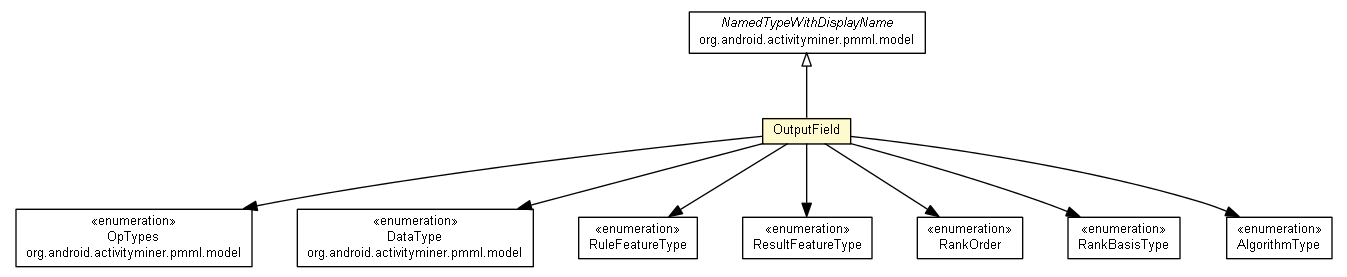
Package class diagram package OutputField
java.lang.Object
  extended by org.android.activityminer.pmml.model.NamedTypeWithDisplayName
      extended by org.android.activityminer.pmml.model.output.OutputField

public class OutputField
extends NamedTypeWithDisplayName

The output field representation (without extensions and decision)


Field Summary
private  AlgorithmType algorithm
          The attribute algorithm specifies which scoring algorithm to use when computing the output value.
private  DataType dataType
          The dataType of an OutputField element specifies the default column type.
private  ResultFeatureType feature
          The attribute feature specifies the value the output field takes from the computed mining result.
private  boolean isMultiValued
          Deprecated. 
private  OpTypes optype
          The opType can be used to indicate admissible operations on the values.
private  int rank
          The attribute rank is used to specify the rank of the feature value from the mining result that should be selected.
private  RankBasisType rankBasis
          The attribute rankBasis applies only to Association Rules and is used to specify which criterion is used to sort the output result.
private  RankOrder rankOrder
          The attribute rankOrder determines the sorting order when ranking the results.
private  RuleFeatureType ruleFeature
          Deprecated. 
private  String segmentId
          The attribute segmentId is applicable to MiningModels which utilize Segmentation.
private  String targetField
          If present, the attribute targetField must refer either to a MiningField of usage type target.
private  String value
          The attribute value is used in conjunction with result features referring to specific values.
 
Constructor Summary
OutputField()
           
 
Method Summary
 AlgorithmType getAlgorithm()
          Getter for the algorithm
 DataType getDataType()
          Getter for the dataType
 String getDataTypeValue()
          Getter for the dataType string value
 ResultFeatureType getFeature()
          Getter for the feature
 String getIsMultiValuedValue()
          Getter for the isMultiValued
 OpTypes getOptype()
          Getter for the optype
 int getRank()
          Getter for the rank
 RankBasisType getRankBasis()
          Getter for the rankBasis
 RankOrder getRankOrder()
          Getter for the rankOrder
 RuleFeatureType getRuleFeature()
          Getter for the ruleFeature
 String getSegmentId()
          Getter for the segmentId
 String getTargetField()
          Getter for the targetField
 String getValue()
          Getter for the value
 boolean isMultiValued()
          Getter for the isMultiValued
 void setAlgorithm(AlgorithmType algorithm)
          Setter for the algorithm
 void setDataType(DataType dataType)
          Setter for the dataType
 void setDataTypeValue(String dataType)
          Setter for the dataType string value
 void setFeature(ResultFeatureType feature)
          Setter for the feature
 void setIsMultiValuedValue(String isMultiValued)
          Setter for the isMultiValued
 void setMultiValued(boolean isMultiValued)
          Setter for the isMultiValued
 void setOptype(OpTypes optype)
          Setter for the optype
 void setRank(int rank)
          Setter for the rank
 void setRankBasis(RankBasisType rankBasis)
          Setter for the rankBasis
 void setRankOrder(RankOrder rankOrder)
          Setter for the rankOrder
 void setRuleFeature(RuleFeatureType ruleFeature)
          Setter for the ruleFeature
 void setSegmentId(String segmentId)
          Setter for the segmentId
 void setTargetField(String targetField)
          Setter for the targetField
 void setValue(String value)
          Setter for the value
 
Methods inherited from class org.android.activityminer.pmml.model.NamedTypeWithDisplayName
getDisplayName, getName, setDisplayName, setName
 
Methods inherited from class java.lang.Object
clone, equals, finalize, getClass, hashCode, notify, notifyAll, toString, wait, wait, wait
 

Field Detail

optype

private OpTypes optype
The opType can be used to indicate admissible operations on the values.


dataType

private DataType dataType
The dataType of an OutputField element specifies the default column type.


targetField

private String targetField
If present, the attribute targetField must refer either to a MiningField of usage type target. The targetField is a required attribute in case the model has multiple target fields.


feature

private ResultFeatureType feature
The attribute feature specifies the value the output field takes from the computed mining result.


value

private String value
The attribute value is used in conjunction with result features referring to specific values. For example, when used with the feature probability, the attribute value indicates the category for which a probability is returned. When not specified, the probability of the predicted categorical value should be returned as an output.


ruleFeature

@Deprecated
private RuleFeatureType ruleFeature
Deprecated. 
An output field may contain an association rule or any of its properties. ruleFeature specifies which feature of an association rule to return. This attribute has been deprecated as of PMML 4.2. The rule feature values can now be specified in the feature attribute.


algorithm

private AlgorithmType algorithm
The attribute algorithm specifies which scoring algorithm to use when computing the output value. It applies only to Association Rules models.


rank

private int rank
The attribute rank is used to specify the rank of the feature value from the mining result that should be selected. It can be used with models that rank the possible outcomes (e.g. classification, clustering, score cards, association rules). When not specified, the winning outcome is returned. When specified, the outcome of the particular rank is returned instead. For example, scorecards can return multiple reason codes depending on the complexity of the scorecard. If the scorecard computes multiple reason codes, rank="1" returns the top reason code. To return other reason codes, rank must be set to the appropriate index. Note that the attribute rank cannot be used together with the attribute value.


rankBasis

private RankBasisType rankBasis
The attribute rankBasis applies only to Association Rules and is used to specify which criterion is used to sort the output result. For instance, the result could be sorted by the confidence, support or lift of the rules.


rankOrder

private RankOrder rankOrder
The attribute rankOrder determines the sorting order when ranking the results. The default behavior (rankOrder="descending") indicates that the result with the highest rank will appear first on the sorted list.


isMultiValued

@Deprecated
private boolean isMultiValued
Deprecated. 
The attribute isMultiValued indicates that the output can represent multiple output values. This attribute has been deprecated as of PMML 4.2. If the value of the attribute is "1", then the rank value indicates the number of output values that should be returned - a positive value indicates the number of output values to be returned, based on the rankBasis and rankOrder, while a zero value indicates that all output values are to be returned. If the value of isMultiValued is "0" (default), then rank indicates a particular output, as defined above.


segmentId

private String segmentId
The attribute segmentId is applicable to MiningModels which utilize Segmentation. This attribute provides an approach to deliver results from Segments which avoids having to specify Outputs within each Segment. If the segmentId attribute matches the id attribute of a Segment within the scope of this model element (the model element containing this OutputField's parent Outputs element), and if the predicate of that segment is true, then this OutputField returns the specified result feature from the sub-model contained within the specified segment. If there is no Segment matching segmentId or if the predicate of the matching Segment evaluated to false, then by convention the result delivered by this OutputField is missing. The features decision or transformedValue may be used along with a segmentId, to refer to an output value of the particular segment. In this case, the attribute value must also be specified and it must refer to the name of the output field of the segment for the decision or transformed value of interest. In addition, the output field of the mining model should not specify an EXPRESSION.

Constructor Detail

OutputField

public OutputField()
Method Detail

setOptype

public void setOptype(OpTypes optype)
Setter for the optype

Parameters:
optype - the optype to set

getOptype

public OpTypes getOptype()
Getter for the optype

Returns:
the optype

setDataTypeValue

public void setDataTypeValue(String dataType)
Setter for the dataType string value

Parameters:
dataType - the dataType to set

getDataTypeValue

public String getDataTypeValue()
Getter for the dataType string value

Returns:
the dataType

setDataType

public void setDataType(DataType dataType)
Setter for the dataType

Parameters:
dataType - the dataType to set

getDataType

public DataType getDataType()
Getter for the dataType

Returns:
the dataType

setTargetField

public void setTargetField(String targetField)
Setter for the targetField

Parameters:
targetField - the targetField to set

getTargetField

public String getTargetField()
Getter for the targetField

Returns:
the targetField

getFeature

public ResultFeatureType getFeature()
Getter for the feature

Returns:
the feature

getValue

public String getValue()
Getter for the value

Returns:
the value

getRuleFeature

public RuleFeatureType getRuleFeature()
Getter for the ruleFeature

Returns:
the ruleFeature

getAlgorithm

public AlgorithmType getAlgorithm()
Getter for the algorithm

Returns:
the algorithm

setFeature

public void setFeature(ResultFeatureType feature)
Setter for the feature

Parameters:
feature - the feature to set

setValue

public void setValue(String value)
Setter for the value

Parameters:
value - the value to set

setRuleFeature

public void setRuleFeature(RuleFeatureType ruleFeature)
Setter for the ruleFeature

Parameters:
ruleFeature - the ruleFeature to set

setAlgorithm

public void setAlgorithm(AlgorithmType algorithm)
Setter for the algorithm

Parameters:
algorithm - the algorithm to set

getRank

public int getRank()
Getter for the rank

Returns:
the rank

getRankBasis

public RankBasisType getRankBasis()
Getter for the rankBasis

Returns:
the rankBasis

getRankOrder

public RankOrder getRankOrder()
Getter for the rankOrder

Returns:
the rankOrder

setRank

public void setRank(int rank)
Setter for the rank

Parameters:
rank - the rank to set

setRankBasis

public void setRankBasis(RankBasisType rankBasis)
Setter for the rankBasis

Parameters:
rankBasis - the rankBasis to set

setRankOrder

public void setRankOrder(RankOrder rankOrder)
Setter for the rankOrder

Parameters:
rankOrder - the rankOrder to set

setMultiValued

public void setMultiValued(boolean isMultiValued)
Setter for the isMultiValued

Parameters:
isMultiValued - the isMultiValued to set

isMultiValued

public boolean isMultiValued()
Getter for the isMultiValued

Returns:
the isMultiValued

setIsMultiValuedValue

public void setIsMultiValuedValue(String isMultiValued)
Setter for the isMultiValued

Parameters:
isMultiValued - the isMultiValued to set

getIsMultiValuedValue

public String getIsMultiValuedValue()
Getter for the isMultiValued

Returns:
the isMultiValued

getSegmentId

public String getSegmentId()
Getter for the segmentId

Returns:
the segmentId

setSegmentId

public void setSegmentId(String segmentId)
Setter for the segmentId

Parameters:
segmentId - the segmentId to set